
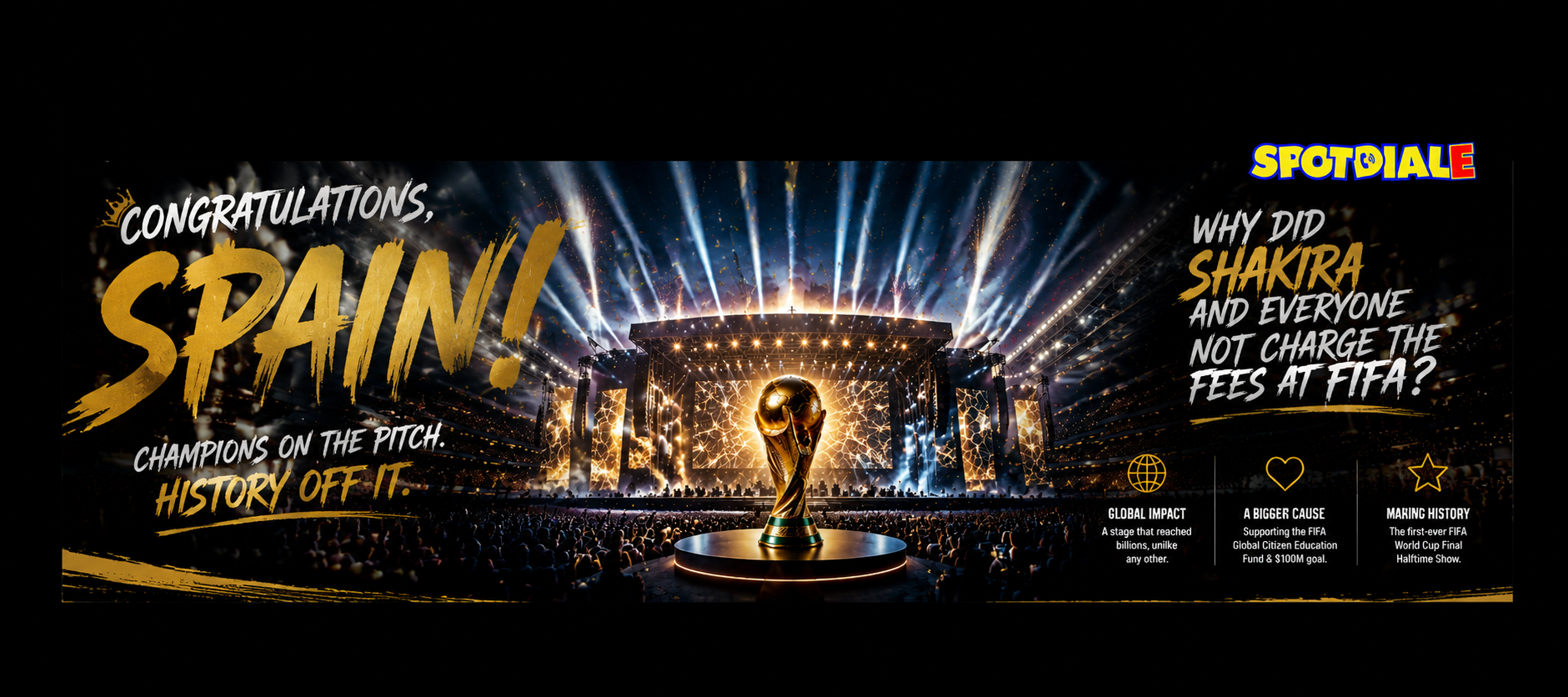
FIFA World Cup 2026 Didn't Just Crown a Champion — It Changed Live Entertainment Forever
Spain lifted the trophy. But the biggest surprise of the night wasn't football — it was music.
For the first time in FIFA World Cup history, the Final featured an official halftime show.
What looked like an 11-minute performance was actually a major shift in how the world's biggest sporting events will work from now on.
Music is no longer just entertainment between matches. It is becoming part of the event itself.
From global superstars sharing one stage to a fundraising mission that reached billions of viewers, FIFA's first-ever halftime show marked the beginning of a new era for artists, promoters, brands, and live entertainment.
Let's break down why this moment matters far beyond football.
Spain Won the World Cup. Music Won the Spotlight.
On July 19, 2026, at New York New Jersey Stadium in East Rutherford, New Jersey, substitute Ferran Torres scored in the 106th minute to hand Spain a 1-0 victory over Argentina in the FIFA World Cup 2026 Final.
Spain's second World Cup title — their first since 2010 — will always be remembered.
But as the teams prepared to take the field, another historic milestone had already captured global attention.
FIFA introduced its first-ever World Cup Final Halftime Show, officially titled the Topps Final Halftime Show, bringing together some of the biggest names in music on one of the largest stages in the world.
It wasn't simply another concert. It was proof that sport and entertainment are becoming inseparable.
Full match report and highlights on FIFA.com
The Lineup: One Stage, Every Genre
The 11-minute show was curated by Chris Martin of Coldplay and produced by Global Citizen in partnership with Live Nation and Done + Dusted.
The performers:
- Madonna opened the show performing "Music" on roller skates, accompanied by Brazilian football legends Ronaldo and Ronaldinho
- BTS — all seven members — performed live
- Justin Bieber delivered a stripped-down acoustic performance of "Everything Hallelujah" after a pep talk from Jason Sudeikis in character as Ted Lasso
- Shakira and Burna Boy performed "Dai Dai," the official FIFA World Cup 2026 anthem, with Uganda's Ghetto Kids — widely called the highlight of the night
- Gustavo Dudamel, conductor and Music Director of the New York Philharmonic, led approximately 40 musicians on the field
- PS22 Chorus, elementary school students from Staten Island, closed the show alongside Chris Martin, Kermit the Frog, Miss Piggy, Cookie Monster, and more Muppets and Sesame Street characters in a finale built around the word "LOVE"
Pop. Latin. K-pop. Afrobeats. Classical. Children's choirs. Puppets.
Instead of competing, these genres and worlds collaborated. That sends a clear message to the live entertainment industry.
Full performer breakdown and reviews on Billboard
Why Did Artists Perform for Free?
At first glance it seems surprising.
Why would some of the world's biggest artists perform without a traditional performance fee?
Because the value was not in the paycheck. It was in the impact.
Global Reach
The FIFA World Cup Final attracts billions of viewers across television, streaming platforms, social media, and news outlets. Few events on Earth provide that level of visibility. One performance becomes global marketing.
Supporting a Bigger Cause
The halftime show supported the FIFA Global Citizen Education Fund, working toward raising $100 million for children's education and football opportunities worldwide.
The performance was not only about entertainment. It was a worldwide campaign with a meaningful purpose.
Learn more about the FIFA Global Citizen Education Fund
Making History
Every artist on stage became part of something that had never happened before — the first FIFA World Cup Final Halftime Show. Moments like these become part of entertainment history, and for artists, that legacy often matters more than a performance fee.
The "Dai Dai" Moment
If one performance stood out above all others, it was Shakira and Burna Boy performing "Dai Dai" — the official song of the 2026 FIFA World Cup.
The track was heard before all 104 matches of the tournament. Written by Shakira, Burna Boy, Ed Sheeran, Jon Bellion, Benny Adam, and Alexander Castillo, it hit the Billboard Global 200 and became the soundtrack of an entire tournament.
Performing it live, surrounded by Uganda's Ghetto Kids dancing, was described by Time Magazine as the show's finest moment.
This was Shakira's fourth official FIFA World Cup song — and arguably her most global moment yet.
Read the Time review of the halftime show
What This Means for Afrobeats
Burna Boy's appearance at the FIFA World Cup Final confirmed something the music industry has been watching for years.
Afrobeats has experienced explosive international growth over the last decade. A co-written official anthem and a halftime performance at the world's most watched sporting event is not a niche genre moment. It is mainstream global entertainment.
African music has officially arrived on the biggest stage possible.
Behind Every Great Performance Is Great Planning
Spectacular performances don't happen by accident.
The Topps Final Halftime Show was produced by Global Citizen in partnership with Live Nation and Done + Dusted. Gustavo Dudamel's orchestra pre-recorded their music at the Manhattan Center on Wednesday before the match to ensure perfect audio on the day.
Behind every successful live show is months of careful preparation. Professional artist contracts now extend beyond appearance fees. They include stage layouts, barrier specifications, crowd management, security planning, technical riders, production schedules, artist hospitality, and emergency planning.
Professional artists don't simply book performances. They protect themselves through well-planned agreements.
What This Means for Emerging Artists
You don't need to headline the FIFA World Cup to learn from it.
Every artist, regardless of audience size, benefits from professional contracts, safety planning, better stage preparation, stronger collaborations, and strategic branding.
These habits separate hobbyists from professionals.
What Does This Mean for India?
As global sporting events continue embracing music, one question naturally follows.
Which Indian artist deserves to perform at the next FIFA World Cup Final?
India has world-class musicians across every genre — from Bollywood to indie artists, from classical performers to hip-hop creators. The opportunity isn't impossible. It's only a matter of time.
The artists preparing today could become tomorrow's global performers.
How SpotDiale Helps Artists Build Toward Opportunities Like These
Moments like the FIFA World Cup halftime show remind us that successful artists don't just rely on talent — they rely on preparation, mentorship, and the right opportunities.
At SpotDiale, we believe every artist deserves access to experienced mentors, personalized guidance, and real performance opportunities.
Whether you're learning your first instrument, building your stage presence, or preparing for professional bookings, the goal is the same: helping artists grow with confidence and industry-ready skills.
The world's biggest stages are built one performance at a time.
Final Thoughts
The FIFA World Cup 2026 Final will always be remembered for Spain's triumph and Ferran Torres' 106th-minute winner.
But years from now, many people may also remember it as the night football officially embraced live music on its biggest stage.
This wasn't just another halftime show. It was a glimpse into the future of entertainment — where sports, music, brands, creators, and audiences come together to create moments that are bigger than any one performance.
And for artists everywhere, that's an opportunity worth preparing for.
Full FIFA World Cup 2026 Final coverage on FIFA.com
Sources: FIFA.com, Forbes, Billboard, NPR, NBC New York, CBC News, Time Magazine, ESPN, Global Citizen